Rebirth Wealth Collective

Latest Resources

Education for the Strategic Rebuilder.

Compliance-first articles on financial profile review, funding readiness, and rebuilding with structure.

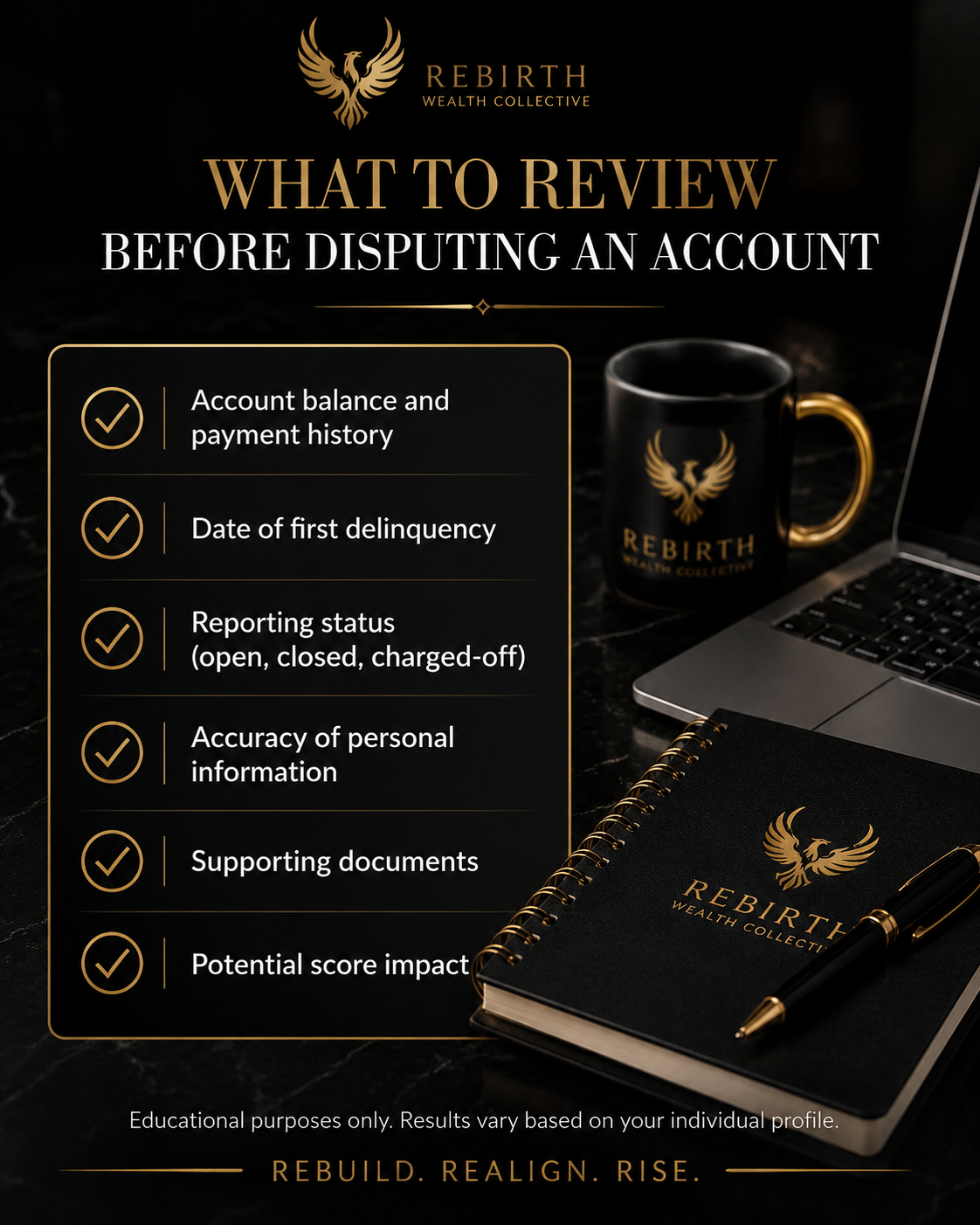
What to review before disputing an account — checklist graphic

What to Review Before Disputing an Account

Before sending a single dispute, here's the structured checklist that helps you identify what's actually worth addressing.

Most people rush into disputes without first understanding what their consumer data actually shows. The result: scattered effort, weak documentation, and outcomes that depend on luck rather than structure.

Start by pulling all three consumer reports and reviewing them side-by-side. Look for inconsistencies in dates, balances, account statuses, and reporting frequency. These are the kinds of details a strategic audit surfaces — not the kinds of things shortcut services notice.

Document everything before you dispute anything. Educational review first, action second. That sequence is the difference between a clean financial profile and a noisy one.


How to prepare your financial profile for funding — step-by-step graphic

How to Prepare Your Financial Profile for Funding

A funding-ready profile is built on structure. Here's the educational framework to know before you apply.

Funding readiness isn't a score — it's a profile. Lenders look at how your data tells a story: stability, consistency, utilization patterns, and the structural details that signal preparedness.

Before applying, review your financial profile the way a lender will. Are your reporting cycles consistent? Are your utilization patterns within healthy ranges? Are there structural gaps that need education or strategy before action?

The goal is not to chase approval. The goal is to present a profile that is ready, organized, and clearly educated — which is exactly what the Financial Audit Protocol is designed to help you build.

Why structure beats shortcuts — comparison infographic

Why Structure Beats Shortcuts

Shortcuts feel productive — until they cost you. Why long-term wealth rewards strategy and structure.

Shortcuts are seductive because they feel like progress. But in financial rebuilding, the fastest path is rarely the most durable one. Real outcomes require structure: documented data, sequenced steps, and informed decisions.

Structure is what separates clients who rebuild once from clients who keep rebuilding the same problems every two years. The Audit Before Action principle exists for exactly this reason — when you understand the data, the strategy becomes obvious.

Wealth is the byproduct of structure repeated over time. Every audit, every checklist, every educational decision is a small structural commitment that compounds.

Audit before action — financial review framework graphic

Audit Before Action

Why every meaningful financial move should start with a structured audit of your current profile.

Action without audit is guesswork dressed up as effort. Before disputing accounts, paying collections, or applying for funding, the most strategic move is to pause and review.

An audit reveals what your data actually shows — not what you assume it shows. That distinction is the difference between targeted progress and scattered effort that costs you time, money, and momentum.

Audit Before Action is more than a slogan. It's the operating principle that turns financial rebuilding from a guessing game into a structured, repeatable process.

The hidden cost of financial guesswork — risk visualization

The Hidden Cost of Financial Guesswork

Guesswork doesn't just slow you down — it quietly compounds against you. Here's what it really costs.

Every uninformed dispute, premature funding application, and reactive payment decision carries a cost most people never measure. Inquiries stack up. Reporting cycles get disrupted. Opportunities quietly disappear.

Financial guesswork is expensive precisely because it doesn't feel expensive. There's no invoice, no line item — just slower progress, weaker outcomes, and rebuilding the same problems on a longer timeline.

Structure, audits, and education don't just save money. They eliminate the invisible tax of guessing — and replace it with the compounding return of informed decisions.

Book Your Audit